The Hidden Cost of Rigorous Pre-Acceptance Review
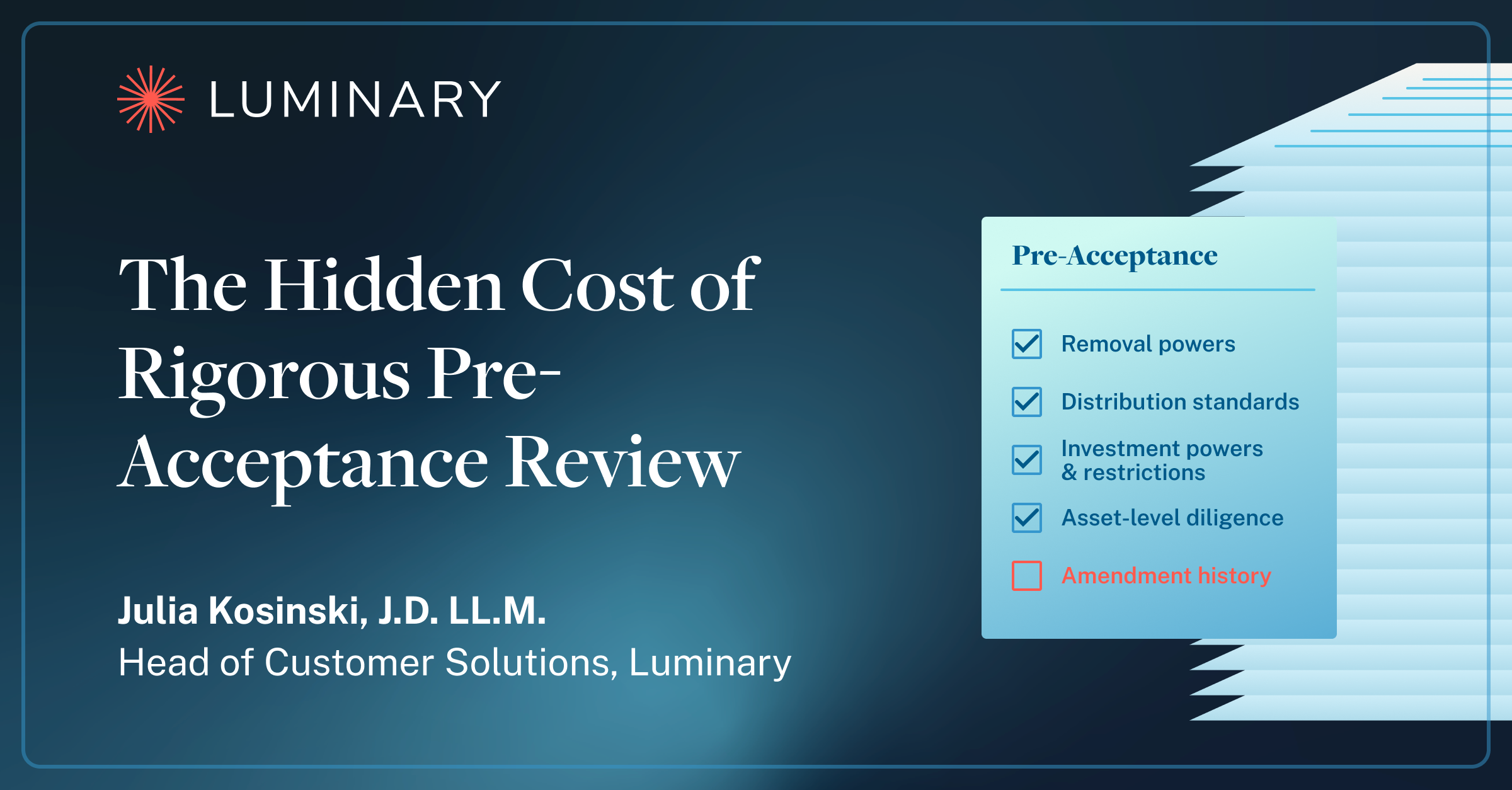

Trust acceptance isn’t a formality: the diligence floor that doesn’t move for a deal timeline.
Every acceptance decision is really two decisions: can we administer this trust, and can we administer it well. Both have to be answered before the business development timeline forces an answer of its own.
The tension here is often described as diligence versus speed, as if the two were competing values to be balanced against each other. That's not quite right. The analysis has a floor, and it doesn't move no matter how quickly business development wants it to, because accepting trusteeship means inheriting a document you didn’t draft, decisions you didn’t make, and beneficiaries you don’t yet know, all before day one, with little real opportunity to negotiate around a problematic provision once the corporate trustee has already said yes.
What’s less obvious is how much of the real exposure sits in the interaction between provisions rather than in any one of them. A removal power and a discretionary distribution standard, read separately, look like two unremarkable line items. Read together, they can be the difference between genuine trustee discretion and a rubber stamp.
That’s not a document-retrieval problem a keyword search or a generic AI summarization tool can solve. It’s a synthesis problem, and it only surfaces when the instrument, its full amendment history, and the trustee’s actual practice are read against each other.
What The Review Has To Cover
A competent review checks removal powers, distribution standards, investment authority, and asset composition individually, and that much is table stakes.
What gets missed more often is how they interact: a trust protector holding the power to remove the corporate trustee without cause doesn’t, by itself, compromise the trustee's independence. But it changes the incentive structure the trustee operates under when applying a discretionary standard, and a trustee who can be replaced at will by the person requesting a distribution has reason to approve rather than question.
The same removal-power pressure shows up on the asset side, too: a trustee who can be removed at will has less room to push for a prudent exit from a concentrated, illiquid position — a closely-held business interest, an oil and gas interest, real property with potential CERCLA exposure — than the instrument’s language alone would suggest. Reviewing these as separate line items, rather than as one combined question, is where the real exposure tends to get missed.
The Amendment History Problem
A trust is rarely just the original document, and reconstructing the full chain of restatements, situs changes, trust protector actions, and decanting is ultimately a matter of understanding what governing law actually applies to the trust today, which is not always the law in effect when the original instrument was signed.
Decanting is usually the vehicle: trustees frequently decant to move a trust to a more favorable jurisdiction, whether for a better directed-trust statute, no state income tax, or a longer or unlimited perpetuities period, so it's often the deliberate result, not an accident, that the new instrument carries a different governing law provision than the original. A well-drafted decanting instrument redrafts its provisions for that new jurisdiction rather than carrying the original trust's language forward unchanged.
The complication arises when it doesn't, and a distribution standard, a rule against perpetuities savings clause, or a trustee exculpation provision written under the original jurisdiction's law gets reused in the new instrument without being updated for the law that now actually governs it. A savings clause drafted assuming common-law RAP, for instance, can become either meaningless or a live trap if it's simply carried into a trust now sitused in a state that has abolished RAP for trusts or adopted USRAP — not because anyone decided it should work that way, but because the provision was never reconsidered when the jurisdiction changed.
That’s the kind of gap a document-by-document review done under time pressure is most likely to miss: not a missing document, but an unreconciled one.
Set up a demo to see for yourself
Where Manual Review and General-Purpose AI Both Fall Short
Getting the acceptance decision wrong isn't just a matter of declining good business or accepting bad business. It means administering a fiduciary relationship that is already exposed — potentially without full visibility into that exposure until a beneficiary dispute brings it to the surface.
That's a difficult position for any trust company to find itself in, and the cost isn't limited to the account itself. Reputational damage and actual fiduciary liability are the larger concern.
Manual document review across a full amendment history doesn't scale well, and general-purpose AI tools aren't built to track fiduciary-specific issues such as removal powers, standard of care language, statutory grandfathering, across a full document chain with citation-level accuracy.
Consistency matters here for a reason beyond any single account: a trust company wants its acceptance review conducted the same way every time, not only because each trust deserves that rigor on its own terms, but because a repeatable, defensible process is itself a form of institutional protection. In practice, trust companies are spending considerable attorney and trust officer time reconstructing the same synthesized history for every acceptance decision, largely from scratch, each time.
A New Data Intelligence Layer
What's needed, then, is an intelligence layer purpose-built for this review: citation-backed document querying, synthesized amendment histories, full-plan overviews, and issue-spotting tuned to what a trust company specifically needs to flag before acceptance — not a generic summarization tool applied to a problem it wasn't built to solve. And the opportunity extends beyond the acceptance decision itself.
The same structured understanding of a trust — its distribution standard, its power, and its governing law history — that a rigorous pre-acceptance review requires is exactly what’s needed to administer the trust well afterward to inform distribution decisions, investment reviews, and compliance monitoring over the life of the account, not just the decision to take it on.
Treating pre-acceptance review as a standalone, one-time hurdle overlooks that the same purpose-built infrastructure making the review faster and more consistent is what should be powering trust administration long after the account is accepted.
The Cost of the Bottleneck
None of this is helped by the real business pressure running in the opposite direction: business development wants a fast yes or no, and a genuinely rigorous review will always compete with that expectation.
That tension isn’t a flaw in the process, it’s inherent to it. But its cost isn’t limited to the acceptance decision a trust company gets wrong. There's a case to be made that this tension has also shaped who ends up as a corporate trustee's client at all: a slow, expensive acceptance process tends to filter for large, straightforward accounts where the economics justify the time, and filter out smaller or more complex relationships where a family might otherwise have wanted a corporate trustee's independence and administration, but couldn't get through underwriting on a reasonable timeline, or where the cost of that diligence made the account uneconomical for the client, the trust company, or both.
Seen this way, the diligence-versus-speed tension isn't only a risk question. It's also a capacity question: how much existing demand for corporate trusteeship never becomes a signed account, simply because the acceptance process itself is the bottleneck. A trust company that can compress the time and cost of a rigorous review, without lowering the floor, isn't just managing risk more efficiently - it's widening the set of relationships, and revenue, it can take on in the first place.
Luminary's domain-specific AI and estate data model help trust companies run pre-acceptance reviews with speed, consistency, and confidence. Schedule time with a Luminary expert here to learn more about how we support pre-acceptance review and trust administration more broadly.