Introducing Luminary Reviews: A New Era for Trust Administration
Introducing Trust Reviews, a breakthrough in how trust companies put AI to work. Built on Luminary’s document intelligence and configured around your firm’s process, Trust Reviews reads trust agreements, amendments, wills, and codicils, reasons through your review criteria, and delivers structured answers grounded in the exact language of each document.

For decades, trust teams have relied on careful document review and rigorous checklists, working through one question at a time. Today, the documents are longer, the stakes are higher, and more assets are held in trust than ever before. Much of that review still happens by hand, even as AI changes how other areas of wealth management work.
Today, Luminary is introducing Trust Reviews, a breakthrough in how trust companies put AI to work. Built on Luminary’s document intelligence and configured around your firm’s process, Trust Reviews reads trust agreements, amendments, wills, and codicils, reasons through your review criteria, and delivers structured answers grounded in the exact language of each document.
An Industry at an Inflection Point
The opportunity in front of trust companies is generational. Estates are reaching record size, more families are choosing trusts for the privacy and protection they offer, and wealth management firms are partnering with or acquiring trust companies to serve clients from end to end.
That opportunity comes with higher expectations. Beneficiaries, many of them digital natives, expect the speed and transparency they’ve grown accustomed to, and more firms than ever are competing to serve them. And every decision a trustee makes also needs a clear record behind it, ready for the day a beneficiary or auditor asks how it was reached.
Meeting those expectations starts with the documents. Every distribution, review, and decision traces back to the language of the trust, and that language lives in long, complex agreements that have only ever been unpacked by a careful human read. AI that can read and reason through those documents makes faster service, consistent decisions, and a clear, auditable record possible at the same time.
The Missing Piece in Trust Technology
Trust companies already use CRMs to manage relationships and accounting platforms to track assets, monitor tasks, and perform accounting tasks. What’s been missing is technology that understands the trust itself: the provisions, amendments, and exceptions that determine what a trustee can and should do.
Without it, the most judgment-heavy work has stayed manual. A single pre-acceptance review can involve a hundred or more questions and roughly six hours of reading the agreement, reconciling each amendment, and retyping answers into another system. Because every reviewer works through the documents a little differently, results can vary from one review to the next, even within the same firm.
Closing that gap at scale takes more than keyword search or generic summaries. It takes AI that can interpret provisions, reconcile amendments against the original agreement, spot the unusual terms that carry risk, apply a firm’s proprietary judgement, and show exactly where each answer came from. That’s the problem Trust Reviews was built to solve.

AI That Understands the Trust Itself
Trust Reviews brings a breakthrough level of intelligence to the documents at the center of trust administration. Your team uploads the agreement along with any amendments, wills, or codicils, and Luminary’s AI reads them together, interprets their provisions, and works through your firm’s review one question at a time.
What comes back is a fully prepared review: a structured answer to every question, the reasoning behind it, and the quoted language that supports it.
- Your firm’s review, prepared automatically: Every answer follows your required information, flagged provisions, and issue-spotting rules.
- Reasoning you can see: Each answer shows how the AI reached it, with the cited clause open right beside it.
- Attention where it’s needed: Luminary flags answers that warrant a closer look, along with questions the documents don’t answer, so your team knows where to start.
- Human judgment on the record: Reviewer edits and added references stay with the review, separate from the AI’s sourced findings.
- Work that travels: Export to PDF or Word, or send completed reviews directly into WealthHub.
- Audit-ready record: Every answer, citation, and reviewer edit is saved with the review, giving you a clear record to return to when a beneficiary or auditor asks how a decision was reached.
A review that once took about six hours can now be completed in under one. Luminary AI handles the reading so your team can focus on the work that has always mattered most: judgment, risk, and the families they serve.

Precision Built Around Your Firm
Accuracy at the level fiduciary work requires comes from pairing powerful AI with deep configuration. Luminary’s Applied AI team builds on the same document intelligence behind the Luminary platform, writing and refining extraction instructions for every question on your firm’s review. The AI can also draw on firm guidance, state trust statutes, and the Uniform Trust Code as cited context.
Before launch, each configuration is tested against your firm’s real cases and compared with answers from your experienced reviewers. The result is AI tuned to the way your firm actually reviews trusts, with consistency and compliance that general purpose AI models cannot support.
Intelligence That Flows Into Your Existing Systems
Trust Reviews offers a two-way integration with WealthHub. Luminary imports your existing review form from your CRM to build your configured review. Once a review is complete, every answer flows back into your system of record as a Trust Document Review record, along with reviewer edits and supporting evidence, so there’s no manual rekeying or double data entry.
Luminary’s implementation team handles the setup, and your CRM remains the system of record for relationships and accounts. Firms without a CRM can use Trust Reviews just as fully.
The Beginning of AI-Native Trust Administration
Trust Reviews launches with pre-acceptance, one of the most complex reviews a trust company performs, and extends to annual reviews, reviews after a death or key event, and special asset reviews. It’s the first major step in Luminary’s vision for an AI-native trust administration platform, built for an industry that has gone without purpose-built technology for decades.
In the coming quarters, Luminary plans to bring the same AI to more of the high-complexity, time-intensive work trust officers handle every day, starting with areas like evaluating beneficiary distribution requests.
Schedule a demo to see how AI can help your firm meet a new era of demand.
Meet the speakers
Keep reading

Introducing Trust Reviews, a breakthrough in how trust companies put AI to work. Built on Luminary’s document intelligence and configured around your firm’s process, Trust Reviews reads trust agreements, amendments, wills, and codicils, reasons through your review criteria, and delivers structured answers grounded in the exact language of each document.
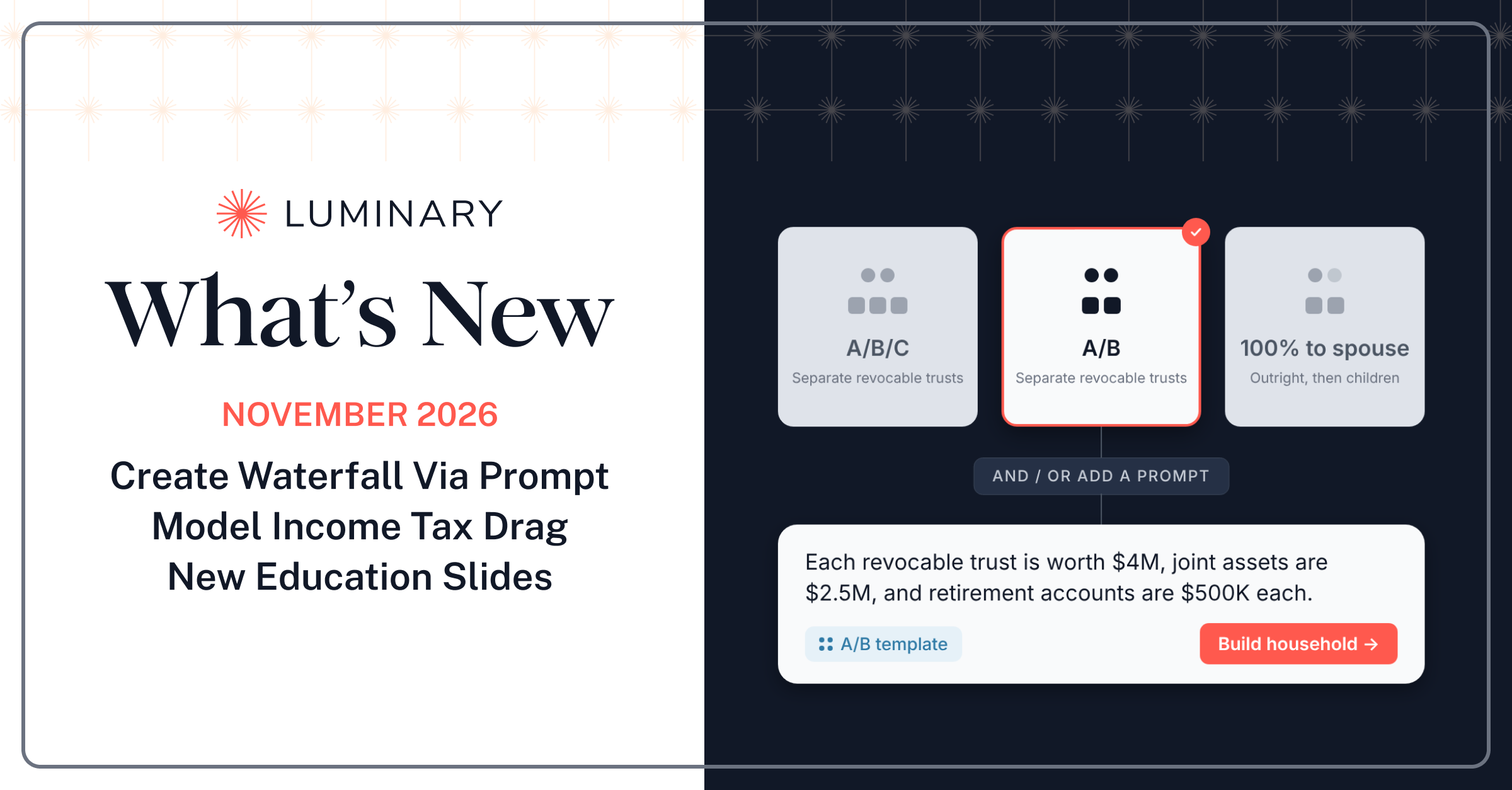
This month, Luminary AI can build a complete estate waterfall from a common plan structure and a few details about the client, with no documents or data entry needed. Projections now account for income tax drag across trusts and entities, so advisors can compare strategies on an after-tax basis. New AI-generated business entity slides, state estate and inheritance tax education slides, and a built-in review and approval step for client presentations round out the release, along with faster, more capable AI behind the scenes.
Subscribe for updates straight to your inbox
Get updates from Luminary